

A sterilizer display that says "cycle complete" tells you the machine ran its programme. It does not prove that steam reached every instrument, or that micro-organisms were killed. That is the job of sterilization monitoring, which combines three kinds of evidence: physical, chemical and biological. This guide explains each one in plain terms.
1. Physical monitoring
The sterilizer's own record of time, temperature and pressure for each cycle, on a printout or data log. It is the first check after every cycle, but it measures the chamber, not the inside of your packs.
2. Chemical indicators (CIs)
Chemical indicators change colour when exposed to one or more sterilization conditions. They are cheap, give an instant result, and go on or inside every pack. The international standard ISO 11140-1 groups them into six types:
| Type | What it is | Typical use |
|---|---|---|
| Type 1: process indicator | Shows a pack has been through a process | Indicator tape, labels, pouch prints |
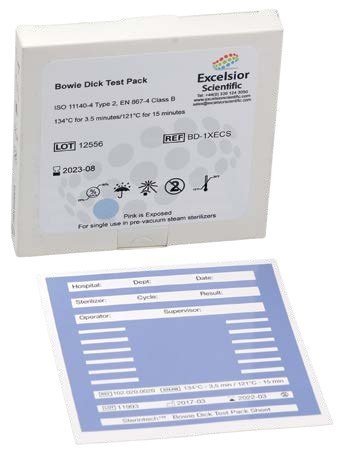
| Type 2: specific test | Tests one function of the sterilizer | Bowie-Dick test for air removal |
| Type 3: single variable | Reacts to one variable, such as temperature | Rarely used today |
| Type 4: multi-variable | Reacts to two or more variables | Inside packs |
| Type 5: integrating | Designed to respond like a biological indicator | Inside packs and implant loads |
| Type 6: emulating | Matches one specific cycle very closely | Inside packs, cycle-specific |
3. Bowie-Dick test
A daily test for pre-vacuum steam sterilizers, run in an empty chamber before the first load. A uniform colour change on the test sheet shows that air was removed and steam penetrated evenly. An uneven result means air leaks or poor air removal, and the sterilizer should not be used until it is checked.
4. Biological indicators (BIs)
A BI carries a known number of highly resistant bacterial spores. After the cycle it is incubated: no growth means the spores were killed. It is the only direct proof of lethality, which is why BIs are used for routine monitoring, after repairs, for implant loads and for validation.
Biological vs chemical: side by side
| Chemical indicator | Biological indicator | |
|---|---|---|
| What it shows | Conditions were reached | Micro-organisms were killed |
| Result time | Immediate | After incubation |
| Where used | Every pack | Test packs, routine and validation |
| Cost per test | Low | Higher |
A simple routine for steam sterilizers
- Every day: a Bowie-Dick test before the first load (pre-vacuum sterilizers).
- Every cycle: check the physical record.
- Every pack: a type 1 indicator outside, and a type 4, 5 or 6 indicator inside.
- Regularly (often weekly), and with every implant load: a biological indicator.
- After repairs or relocation: biological indicator tests before returning to use.
Your local health authority rules and your facility's policy decide the exact frequencies, so treat this as a starting point.
Frequently asked questions
Can a chemical indicator replace a biological indicator?
No. Chemical indicators show that conditions were reached; only a biological indicator shows that micro-organisms were actually killed. Type 5 integrating indicators are designed to respond like a BI, but most policies still require BIs for routine monitoring and implant loads.
What does a failed Bowie-Dick test mean?
It usually means air is not being removed properly, for example because of a door seal leak or vacuum problem. Stop using the sterilizer and have it checked before processing loads.
Where can I buy sterilization indicators in the UAE?
Viyon Scientific in Dubai is the authorised UAE distributor of Excelsior Scientific and supplies biological indicators, chemical indicators, Bowie-Dick packs, tape and pouches across the UAE.
Related pages More guides