

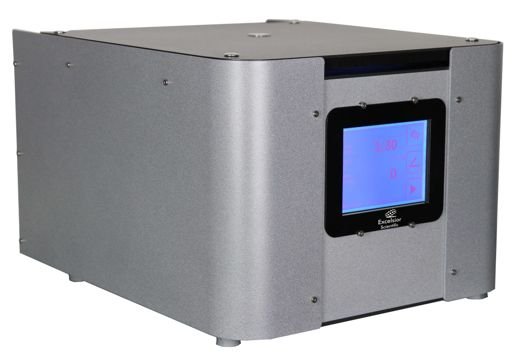
A centrifuge is one of the most used instruments in any lab, and one of the easiest to buy wrong. A model that is too small slows the whole lab down; one without cooling can damage heat-sensitive samples; the wrong rotor gives you poor pellets or no separation at all. This guide walks through the five questions we ask every customer in the UAE before recommending a centrifuge.
1. What g-force (RCF) does your protocol need?
Most protocols state a relative centrifugal force (RCF), written as "x g", not a speed in RPM. RCF is what actually separates your sample. RPM only tells you how fast the rotor turns, and the same RPM gives a different g-force in a different rotor, because RCF depends on the rotor radius.
The conversion is:
RCF = 1.118 × 10⁻⁵ × r × RPM², where r is the rotor radius in centimetres.
For example, a rotor with a 10 cm radius at 4,000 RPM gives about 1,790 x g. The same 4,000 RPM in a rotor with a 15 cm radius gives about 2,680 x g. That is why you should always check the maximum RCF of the rotor you plan to use, not only the top speed of the centrifuge.
| Typical job | Typical g-force range |
|---|---|
| Separating blood serum or plasma | About 1,000 to 2,000 x g |
| Pelleting cells | About 200 to 1,500 x g |
| Microtube work (DNA, protein, spin columns) | Up to about 15,000 to 22,000 x g |
| Pelleting bacteria and fine precipitates | About 5,000 to 15,000 x g |
Ranges are general guidance. Always follow the RCF and time in your own protocol or kit instructions.
2. What tubes and volumes will you spin?
List the tubes you use every week: 0.2 ml PCR strips, 1.5 and 2 ml microtubes, 15 and 50 ml conical tubes, blood collection tubes, bottles of 250 ml or more, or microplates. Then add up how many you need to spin in one run. This decides the size class:
- Microcentrifuge: microtubes and PCR strips only, small footprint, high g-force.
- General-purpose benchtop: 15 and 50 ml tubes plus microtube and blood-tube adaptors; the workhorse of most clinical and research labs.
- Large benchtop (1 to 3 litres): many tubes per run, larger bottles, microplates.
- Floor-standing (4 litres and up): bulk processing in production, blood banks and large research groups.
Choosing one size up from today's need is usually cheaper than buying a second centrifuge in two years.
3. Fixed-angle or swing-out rotor?
| Fixed-angle rotor | Swing-out (swinging bucket) rotor | |
|---|---|---|
| How it works | Tubes are held at a fixed angle | Buckets swing out to horizontal while spinning |
| Best for | Fast pelleting at high g-force | Clean layers and flat pellets, density gradients, blood separation |
| Speed | Higher maximum RCF | Lower maximum RCF, larger capacity |
| Flexibility | One tube size per rotor | Adaptors let one rotor take many tube types |
Many labs buy one of each. If you work with infectious material, ask for sealed (aerosol-tight) buckets or lids, so tubes can be loaded and opened in a biosafety cabinet.
4. Do you need a refrigerated centrifuge?
Every centrifuge warms up as it runs. A refrigerated model holds the chamber at a set temperature, often 4°C, which matters for proteins, enzymes, RNA, live cells and long runs. In UAE labs, where room temperatures can be high and air conditioning works hard in summer, a ventilated (ambient) model may run warmer than you expect on long or high-speed runs. If your protocol says "spin at 4°C", you need refrigeration.
When comparing refrigerated models, look at how tightly the temperature is held, how quickly it pre-cools, and the power the unit draws.
5. Safety and day-to-day features
- Imbalance detection and lid lock: the centrifuge should stop safely if a load is unbalanced and not open while the rotor turns.
- Rotor recognition: stops the rotor being run faster than its rated speed.
- Programme memory: saves your common runs so every user gets the same result.
- Acceleration and braking rates: gentle braking protects layers in gradients and blood tubes.
- Autoclavable rotors and buckets: easier decontamination.
- Noise and footprint: check the bench space, including clearance for ventilation.
A quick checklist before you ask for a quote
- Maximum RCF (x g) and run time in your protocols
- Tube types and how many per run
- Fixed-angle, swing-out, microplate or all three
- Ambient or refrigerated, and the temperature you need
- Containment needs (sealed buckets)
- Bench space and power supply
Centrifuges from Viyon in the UAE
Viyon Scientific is the authorised UAE distributor of Excelsior Scientific, whose Pharma+ and K-series range covers microtube, general-purpose, large benchtop and floor-standing centrifuges, in ventilated and refrigerated versions, with a full rotor and adaptor range. See the models and rotor guide on our centrifuges page, or send us your checklist and our team in Dubai will recommend a model.
Frequently asked questions
What is the difference between RPM and RCF?
RPM is how many times the rotor turns per minute. RCF (relative centrifugal force, written x g) is the force your sample actually feels, and it depends on both speed and rotor radius. Protocols usually state RCF, so use the formula RCF = 1.118 x 10^-5 x radius in cm x RPM squared to find the speed for your rotor.
Do I need a refrigerated centrifuge?
You need one if your protocol specifies a temperature such as 4°C, or if you work with proteins, enzymes, RNA, live cells or long high-speed runs. For routine blood or urine spins, a ventilated model is often enough.
Fixed-angle or swing-out rotor: which is better?
Fixed-angle rotors pellet faster and reach higher g-force. Swing-out rotors give clean, flat layers and take many tube sizes with adaptors. Many labs use both.
Where can I buy a laboratory centrifuge in the UAE?
Viyon Scientific in Dubai supplies Excelsior Scientific microtube, benchtop and floor-standing centrifuges across the UAE. Send your tube types, g-force and capacity needs for a quotation.
Related pages More guides