

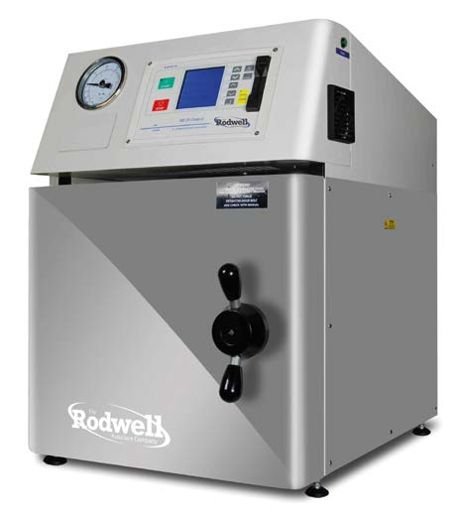
An autoclave sterilizes with pressurised steam, usually at 121°C. It is used to prepare culture media, sterilize glassware and instruments, and make biological waste safe before disposal. Autoclaves are a long-term purchase, often in service for 15 years or more, so it pays to get the specification right. Here is how we help UAE labs choose.
1. What will you sterilize?
Start with the load, because it decides the cycles you need:
- Liquids and culture media: need a liquid cycle with slow, controlled pressure release so bottles do not boil over. Load cooling saves a lot of waiting time.
- Glassware and wrapped instruments: need good steam penetration and a drying stage.
- Biological waste in bags: needs a longer cycle and a chamber and drain that handle spills.
- Porous loads and hollow instruments (typical in hospital CSSD): usually need a vacuum (pre-vacuum) autoclave to remove air.
2. How big should the chamber be?
Work out your largest regular load, then add some headroom. A simple way is to count 1 litre media bottles or waste bags per run. As a rough guide:
| Size class | Typical chamber | Good for |
|---|---|---|
| Portable / tabletop | 15 to 30 litres | Small labs, teaching, occasional media batches |
| Benchtop and compact | 40 to 75 litres | Daily media and glassware in a working lab |
| Medium capacity | 100 to 160 litres | Busy microbiology labs, waste and media together |
| Large and square chamber | 200 to 770 litres | Central sterilization, production, large waste volumes |
It is usually better to run one well-filled cycle than two half-empty ones, but do not overpack the chamber: steam must reach every item.
3. Top-loading or front-loading?
| Top-loading (vertical) | Front-loading (horizontal) | |
|---|---|---|
| Footprint | Small; some fit under a bench | Larger, but can sit on a bench or stand |
| Loading | Lift baskets in from above | Slide loads in at working height; easier with trolleys |
| Cost | Usually lower for the same volume | Higher, with more automation options |
| Best for | Media, tall vessels, tight spaces | Frequent loading, heavy loads, pass-through (double-door) setups |
4. Utilities: power, water and drainage
Check these early, because they often decide which model you can install:
- Power: small autoclaves run on single-phase power; larger ones often need three-phase. Ask your facilities team what is available at the install location.
- Steam source: most labs use electrically heated autoclaves. Sites with a central steam supply can use direct steam models.
- Water quality: use the water quality the manufacturer specifies (often purified or deionised water) to limit scale and protect heaters.
- Drainage and ventilation: autoclaves release hot water and steam, so plan a suitable drain and good room ventilation.
5. Controls, cooling and records
- Programmable cycles: saved cycles for media, glassware and waste reduce operator error.
- Accelerated cooling: cuts the wait before liquid loads can be removed safely.
- Cycle data recording: a printer, USB or software log of temperature, pressure and time for each cycle helps with audits and accreditation.
- Safety interlocks: the door must stay locked while the chamber is under pressure or too hot.
6. How to prove each load is sterile
Reaching 121°C on the display does not prove the inside of every bottle or bag got there. Labs use a mix of checks:
- Chemical indicators (tapes, labels, strips) change colour to show a pack has been through a steam cycle.
- Biological indicators with heat-resistant spores, placed in the hardest-to-reach spot, give the strongest proof that conditions were lethal.
- Bowie-Dick test packs check air removal and steam penetration in vacuum (pre-vacuum) autoclaves, usually at the start of each day.
Follow your own quality system, accreditation body or local health authority for how often to run each test.
A quick checklist before you ask for a quote
- Load types (media, glassware, instruments, waste) and largest load per cycle
- Space available and loading preference (top or front, single or pass-through door)
- Power supply at the install site, and whether central steam is available
- Need for load cooling, drying and cycle data recording
- How you will monitor sterilization (indicators and tests)
Autoclaves from Viyon in the UAE
Viyon Scientific represents The Rodwell Autoclave Company, whose UK-built range runs from 15 litre portable units to 770 litre square-chamber autoclaves, with top-loading, front-loading and pass-through options. We also supply sterilization monitoring products from Excelsior Scientific, including biological and chemical indicators and Bowie-Dick test packs. Browse our autoclaves and sterilization assurance pages, or send us your checklist for a recommendation.
Frequently asked questions
What temperature does a laboratory autoclave use?
Most laboratory cycles run at 121°C, with the hold time set by the load. Some instrument cycles use 134°C for a shorter time. Always validate cycles for your own loads.
What size autoclave does my lab need?
Count your largest regular load, such as the number of 1 litre media bottles or waste bags per run, and add headroom. Small labs often use 15 to 30 litre units, busy labs 40 to 160 litres, and central facilities 200 litres or more.
Top-loading or front-loading autoclave?
Top-loading autoclaves are compact and cost less for the same volume. Front-loading autoclaves are easier to load at working height and suit frequent use, heavy loads and pass-through installations.
Where can I buy a laboratory autoclave in the UAE?
Viyon Scientific in Dubai supplies Rodwell autoclaves from 15 to 770 litres and Excelsior Scientific sterilization indicators across the UAE. Send your load types and space details for a quotation.
Related pages More guides