

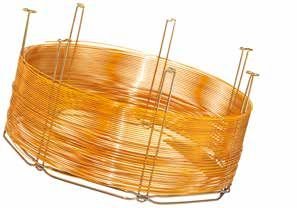
If you're wondering how to choose a GC column, the short answer is: pick the stationary phase first, then the dimensions. The phase decides whether your compounds separate at all. Length, internal diameter and film thickness fine-tune how well and how fast they separate. Most labs can start with a 30 m × 0.25 mm × 0.25 µm column in the right phase and adjust from there.
This guide walks you through the choice in five steps.
Step 1: Choose the stationary phase
The stationary phase is the coating inside the column. It matters most because separation depends on how strongly each compound interacts with it. The basic rule is "like dissolves like": non-polar compounds separate well on non-polar phases, and polar compounds on polar phases.
| Phase type | Polarity | Typical uses | Trajan SGE examples |
|---|---|---|---|
| 100% dimethylpolysiloxane | Non-polar | Hydrocarbons, solvents, petroleum, simulated distillation | BP1 |
| 5% phenyl (or equivalent) | Low polarity | General-purpose work, environmental semi-volatiles, drugs, GC-MS | BPX5 |
| 35–50% phenyl | Mid polarity | Pesticides, PCBs, steroids, confirmation columns | BPX35, BPX50 |
| Cyanopropylphenyl (624 type) | Mid polarity | Volatile organics, residual solvents (e.g. USP <467>) | BP624 |
| Polyethylene glycol (WAX) | Polar | Alcohols, flavours, fragrances, essential oils, solvents | BP20 |
| High cyanopropyl | Very polar | FAME analysis, cis/trans fatty acid isomers | BPX70 |
Tip: If your method is a published standard (ASTM, USP, EPA or EN), it usually names the phase. Choose that phase or a listed equivalent. If you're developing your own method and don't know where to start, a 5% phenyl column is the most versatile first choice.
Step 2: Choose the column length
Length affects resolution and run time.
- 15 m: fast runs for simple mixtures and screening.
- 30 m: the standard for most methods. It balances resolution and speed.
- 60 m and longer: complex samples such as petroleum, fragrances and volatile organics, where many peaks sit close together.
Doubling the length doesn't double resolution. It improves resolution by only about 40%, but roughly doubles the run time and costs more. Add length only when a thinner or narrower column can't give you the separation you need.
Step 3: Choose the internal diameter (ID)
The internal diameter affects efficiency and how much sample the column can handle.
- 0.10–0.18 mm (narrow bore): sharp peaks and fast GC, but low sample capacity. Best for fast GC-MS.
- 0.25 mm: the most common choice. Good efficiency and works with most GC-MS systems.
- 0.32 mm: more sample capacity, easier to use with splitless and on-column injection.
- 0.53 mm (wide bore): high capacity, used for packed-column replacements and some gas and volatile analysis.
If you use GC-MS, check your mass spectrometer's flow limit. Most work well with 0.25 mm columns.
Step 4: Choose the film thickness
Film thickness controls retention and capacity.
- Thin films (0.1–0.25 µm): best for high-boiling compounds such as semi-volatiles and waxes. They also give lower column bleed, which suits GC-MS.
- Standard film (0.25 µm): a good fit for most applications.
- Thick films (1–5 µm): retain very volatile compounds, such as gases and solvents, without needing sub-ambient oven temperatures. They also handle larger sample amounts, but bleed more at high temperatures.
Step 5: Check temperature limits and your instrument
Before you order, confirm three things:
- Temperature limits. The phase must handle your highest oven temperature. Polar WAX phases usually have lower maximum temperatures than non-polar phases.
- Column format. Check the cage or hub size for your GC, for example Agilent, Shimadzu, Thermo or PerkinElmer.
- Fittings and consumables. Order the right ferrules, inlet liners and septa with the column, plus GC vials and caps for your autosampler. Leaks and dirty liners cause more GC problems than the column itself.
Quick reference: common starting columns
| Application | Suggested starting column |
|---|---|
| General-purpose and GC-MS | 5% phenyl, 30 m × 0.25 mm × 0.25 µm |
| Hydrocarbons and petroleum | 100% dimethylpolysiloxane, 30–100 m |
| Residual solvents | 624 type, 30 m × 0.32 mm × 1.8 µm |
| Fragrances and flavours | WAX, 30–60 m × 0.25 mm × 0.25 µm |
| Fatty acid methyl esters | High cyanopropyl, 30–60 m |
Always check these against your method before ordering.
How to make your GC column last longer
- Use a guard column or a retention gap for dirty samples.
- Change inlet liners and septa regularly.
- Use high-purity carrier gas with oxygen and moisture filters.
- Condition the column before first use, following the manufacturer's instructions.
- Trim 10–30 cm from the inlet end when peak shape gets worse.
- Never heat the column above its maximum temperature.
Frequently asked questions
What is the most common GC column?
A 5% phenyl phase in 30 m × 0.25 mm × 0.25 µm dimensions. It suits a wide range of general and GC-MS applications.
Can I use another brand's equivalent column?
Usually, yes. Most phases have equivalents across brands, such as BPX5 for 5% phenyl methods. Check that the equivalent is listed or validated for regulated methods.
How often should I replace a GC column?
There's no fixed interval. Replace it when trimming no longer restores peak shape, bleed becomes too high, or retention times drift outside your limits.
Order GC columns in the UAE
Viyon Scientific is a UAE supplier of Trajan SGE GC columns, inlet liners, septa, ferrules and syringes. We can also source Agilent, Restek, Phenomenex, GL Sciences and Thermo Fisher columns on request. See GC columns in the UAE and GC liners, septa and fittings, or send us your method or part numbers for a quote in AED.
Call +971 56 671 6788 · scientific@viyonmiddleeast.com
Related pages More guides