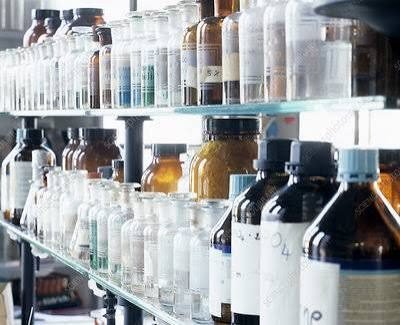
The same chemical can come in five or six laboratory chemical grades, and the price can vary several times over between the lowest and the highest. Ordering the wrong grade costs you either way. Too low, and your blank values rise, peaks appear where they shouldn't, or an auditor rejects your results. Too high, and you're paying for purity your method never needed.
This guide explains what each grade means, where it's used and how to pick the right one for your lab.
What a chemical grade actually tells you
A grade is the manufacturer's promise about purity and about which impurities have been tested and limited. Two bottles of methanol can both be "99.9%" pure and still behave very differently. One may be tested for UV absorbance, residue on evaporation and water content, and the other not. That's why the grade, and the certificate of analysis behind it, matter more than the headline purity number.
The main laboratory chemical grades compared
| Grade | Typical use | What it's tested for | When it's the wrong choice |
|---|---|---|---|
| Technical / industrial | Cleaning, non-analytical processes | Basic purity only | Any analysis or result you report |
| Laboratory (lab grade) | Teaching practicals, general lab work | Purity, a few key impurities | Regulated QC or accredited testing |
| Analytical reagent (AR / ACS) | Routine analysis, titration, sample prep | Purity plus specified impurity limits | Chromatography or trace analysis |
| Pharmacopoeia (USP, EP, BP) | Pharma testing and manufacturing | The tests in that pharmacopoeia monograph | Non-pharma work, where it adds cost |
| HPLC / GC grade | Mobile phases, chromatography sample prep | UV absorbance, residue, water, particles | Trace metal analysis |
| LC-MS grade | LC-MS mobile phases | As HPLC grade, plus low metal ions and MS background | Routine HPLC-UV, where it adds cost |
| Trace metal / ultra-pure | ICP-OES, ICP-MS, AAS, digestion | Dozens of metals at ppb or ppt levels | General titrations or cleaning |
Lab grade vs AR grade: the most common decision
For most labs, the everyday choice is between laboratory grade and analytical reagent (AR) grade.
- Use lab grade for teaching practicals, buffer preparation for non-critical work, and general bench chemistry. It's the right choice for schools and university teaching labs, where cost matters and results aren't reported.
- Use AR grade when a result goes into a report, a certificate or a customer file. Most food, water and industrial QC labs should default to AR grade for titrants, standards preparation and sample work.
If you're not sure, ask one question: "Will someone else rely on this number?" If yes, use AR grade or higher.
When you need HPLC or LC-MS grade solvents
Chromatography is where grade matters most. Standard AR solvents can contain traces of UV-absorbing impurities, stabilisers or non-volatile residue. In HPLC, these show up as a noisy or drifting baseline and ghost peaks, especially in gradient runs.
- HPLC grade is the minimum for mobile phases and for dissolving samples before HPLC or GC injection.
- LC-MS grade goes further, limiting the metal ions and contaminants that form adducts or raise background in a mass spectrometer. Use it only if you run LC-MS. For HPLC with a UV detector, it adds cost without improving results.
- GC and residue-analysis grades are tested for compounds that interfere with GC detectors. They're used for pesticide residue and environmental methods.
Water counts too. Use HPLC-grade water or water from a properly maintained ultrapure water system, not distilled water from a general tap.
When you need trace metal grade acids
If you run ICP-OES, ICP-MS or AAS, the acids you use for digestion and dilution set your detection limit. A standard AR nitric acid can carry enough metal contamination to swamp the low-level results you're trying to measure.
Certified trace-metal and ultra-pure acids are made in clean conditions. They're certified for many elements at very low levels. Use them for:
- Sample digestion for metals analysis
- Preparing calibration standards and blanks
- Rinsing sample containers for trace work
For everything else in the lab, ordinary AR acids are fine and much cheaper.
Pharmacopoeia grades for pharma labs
Pharmaceutical QC labs often need reagents that meet a specific pharmacopoeia, such as USP, EP or BP. These grades are tested against that pharmacopoeia's monograph, which is what your method and regulator will expect to see. Check your method: if it names a pharmacopoeia grade, order exactly that grade and keep the certificate of analysis with your batch records.
Five tips to avoid paying for the wrong grade
- Start from the method. Most standard methods (ASTM, ISO, EPA, USP) state the grade required. Follow it.
- Split your purchasing by use. Buy lab grade for teaching and cleaning, and AR or higher for analysis. Don't buy one top grade for everything.
- Match pack size to usage. A large pack of HPLC solvent that sits open for months absorbs water and loses its quality. Smaller packs often work out cheaper per useful litre.
- Always ask for the certificate of analysis. For accredited and regulated labs, it's part of your evidence.
- Check the storage needs. Flammable solvents, strong acids and oxidisers need proper storage cabinets, especially in UAE summer temperatures.
Frequently asked questions
Is AR grade the same as ACS grade?
They're very close. ACS grade means the chemical meets the American Chemical Society's reagent specifications. AR grade is the common label for analytical reagents that meet similar specifications. For most routine analysis, either works.
Can I use HPLC-grade solvent for general lab work?
You can, but it costs more than you need to pay. Keep HPLC grade for chromatography and use AR grade elsewhere.
Do I need LC-MS grade solvents for HPLC with a UV detector?
Usually not. HPLC grade is designed for UV detection. LC-MS grade is only worth the extra cost when you use a mass spectrometer.
What grade should a school lab buy?
Lab grade is the right choice for most school and teaching practicals. Buy AR grade only for experiments where students measure an exact value.
Get the right grade, quoted together
Viyon Scientific supplies laboratory chemicals and reagents across the UAE, from lab and AR grade chemicals to HPLC solvents, ultra-pure acids and certified reference materials. Send us your list with names or CAS numbers, grades and quantities, and we'll quote everything together in AED. If you only know the method, tell us and we'll suggest the right grade.
Call +971 56 671 6788 · scientific@viyonmiddleeast.com
Related pages More guides